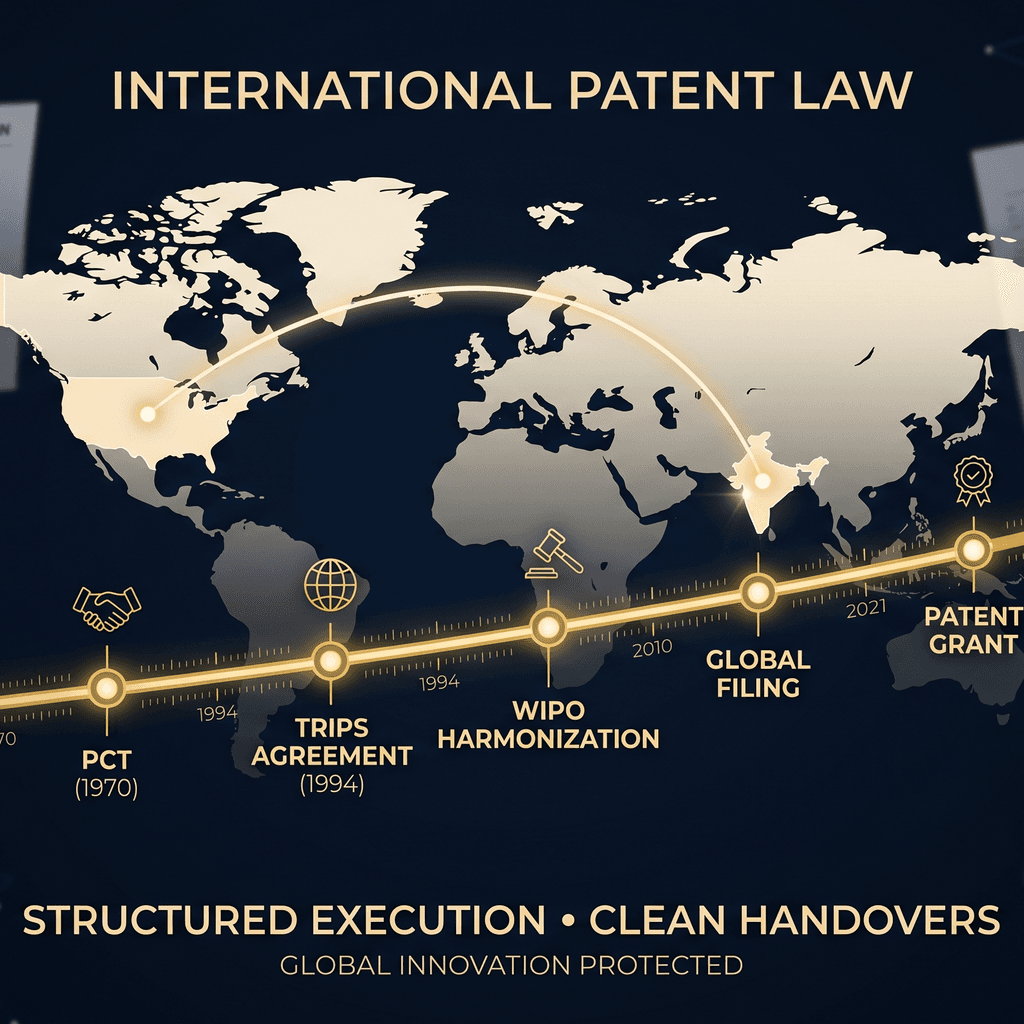
Every so often a fact pattern lands in practice that forces you to slow down and think through first principles. This is one of them. It came up in our community discussions recently and generated enough debate to merit a proper written treatment.
The Fact Pattern
01 Jan 2026 — Inventor A files in the USA: Utility patent application filed at the USPTO for Invention X.
01 Apr 2026 — Inventor B files independently in India: No connection to Inventor A whatsoever. Same invention — arrived at completely independently.
01 May 2026 — Indian application publishes: Inventor B's Indian application enters the public domain.
01 Jul 2027 — US application publishes: Inventor A's US application — filed 18 months earlier — becomes publicly available under standard USPTO publication rules.
01 Aug 2027 — Indian examiner picks up Inventor B's file: Substantive examination begins. The examiner finds Inventor A's now-published US application and raises it as prior art against Inventor B's claims.
The Central Question
Is the Indian examiner's prior art objection based on Inventor A's US application legally valid under the Patents Act 1970?
The Legal Framework: Section 13 of the Patents Act 1970
To answer this properly, we need to start with Section 13 of the Patents Act 1970, which governs how Indian examiners conduct prior art searches and what can constitute anticipatory prior art.
Under Section 13(1)(b), an examiner must investigate whether the invention claimed has been anticipated by prior publication. The critical question is what the statute means by "prior" — and relative to what date.
Indian patent law uses the date of filing of the Indian application as the reference point for anticipation. Anything published before that date — anywhere in the world — is fair game as prior art. Anything published after that date, in principle, is not.
Inventor B's Indian filing date is 01 April 2026. Inventor A's US application published on 01 July 2027 — more than 15 months later.
The Analysis: Three Layers to Work Through
- Publication date vs. filing date: The US application was filed on 01 January 2026 — before Inventor B's Indian filing. But it did not publish until 01 July 2027 — well after. Under Indian law, the relevant event is publication, not filing. At the moment Inventor B filed in India, Inventor A's US application was not publicly available. It was a confidential pending application sitting in the USPTO system. It cannot have anticipated a claim when it was not accessible to the public.
- The "whole contents" doctrine — does it apply here?: Some jurisdictions (notably the UK and EPO) operate a "whole contents" approach under which unpublished earlier applications can constitute prior art for novelty purposes — but only if they are in the same jurisdiction. India does not have a statutory equivalent of this doctrine for cross-border situations. The Indian Patents Act does not extend prior art effect to foreign unpublished applications that had not entered the public domain as of the local filing date.
- The examiner's timing problem: The objection is raised in August 2027, and by then the US application is public. But the legally relevant date is April 2026 — not August 2027. The examiner cannot retroactively apply a document that was not in the public domain when Inventor B established their priority date. The temporal reference point in the novelty analysis is fixed at the date of filing; it does not shift to whenever examination happens to begin.
Analysis Verdict
The objection is, on its face, not legally valid.
Inventor A's US application was not published — and therefore not publicly available — as of Inventor B's Indian filing date of 01 April 2026. Under the Patents Act 1970, prior art must pre-date the filing date of the application under examination. A document that entered the public domain 15 months after that filing date does not satisfy that requirement and cannot be used to establish anticipation of Inventor B's claims.
The Nuances That Matter
What if Inventor A had filed a PCT application? This changes the picture significantly. A PCT application designating India is treated differently. If Inventor A had filed a PCT application before Inventor B's Indian filing date, and that PCT application eventually entered Indian national phase, the PCT application's filing date could be relevant to inventive step analysis — though the mechanics depend on whether it published before the examination date and how the examiner frames the objection.
In this scenario, however, we are told Inventor A filed only a US national application. That application has no direct effect in India and its unfiled, unpublished status as of April 2026 means it carries no prior art weight.
Inventive Step vs. Novelty: The analysis above addresses novelty/anticipation. It is worth noting separately that inventive step (Section 2(1)(ja) of the Patents Act) uses a slightly broader definition — the "state of the art" for inventive step purposes can include material that was available before the priority date, but the same temporal logic applies: as of April 2026, the US application was not available. It does not factor into either analysis.
What the Examiner Should Have Done: A well-formed examination objection would cite prior art that pre-dates 01 April 2026. If Inventor A's US application published in July 2027 is the best anticipatory reference the examiner found, that is actually useful information for Inventor B — it suggests the prior art landscape as of the priority date may have been cleaner than initially feared.
Practical Note
Responding to this objection is a matter of documentary precision: establish the chronology, cite the Indian filing date, confirm the US application's publication date, and argue that no publication prior to 01 April 2026 has been cited. The examiner's citation, while understandable (the US application is the most relevant document), is temporally misplaced.
Cross-Border Filing Strategy: What This Scenario Teaches
This fact pattern is a useful reminder of how temporal sequencing in multi-jurisdictional prosecution can create traps — and how understanding them clearly protects clients.
Independent creation is not a shield indefinitely. Inventor B's independent conception is legally irrelevant to novelty — what matters is what was published, and when. Had Inventor A's US application published before April 2026 (for example, via early publication request, or through a PCT filing that published earlier), the result would be very different.
Filing dates and publication dates are not interchangeable. This scenario illustrates exactly why they need to be tracked separately. Many firms docket filing dates for prior art calendaring purposes but do not systematically track publication dates of third-party applications in foreign jurisdictions. In prosecution, that gap can produce exactly this kind of objection — and exactly this kind of confusion about whether it has merit.
India Collaboration Support matters for cases like this. For international IP firms managing prosecution across USPTO, WIPO, and IP India, coordinated workflow and jurisdiction-specific procedural knowledge reduce the risk of these objections going unresponded or being conceded incorrectly. Knowing which documents qualify as prior art under which statute — and at which date — is not always intuitive across systems.
Conclusion
The short answer: no, the Indian examiner's objection is not legally valid on these facts. The longer answer is that this scenario rewards careful thinking about what "prior art" actually means in the jurisdiction in question — prior to what date, for what purpose, and under which statutory provision.
These details are where prosecution support earns its value. Getting the chronology right, framing the response precisely, and understanding the statutory basis for every objection raised — that is the operational work that keeps prosecution on track.
If you have a cross-border prosecution question or need structured IP operations support across jurisdictions, we are happy to assist.