The Real Problem Is Not the Drawing
When a drawing objection comes back from the USPTO, it almost never surprises the attorney on the substance. The invention is fine. The claims are fine. What's not fine is a margin that crept two millimetres into the restricted zone, a reference numeral that appears in the spec but not the figure, or a view that was omitted because nobody flagged that design patent prosecution requires it. These are not judgment calls. They are execution problems — and they compound. A last-minute correction delays the filing. The filing delay compresses the docketing window. The compressed window creates pressure on the next matter. And somewhere upstream, an illustrator is cycling through a third revision that should have been right the first time. This post lays out exactly what the USPTO requires for patent drawings — not as a beginner's checklist, but as a reference for the professionals who absorb the cost when those requirements are not met.
Where the Execution Friction Shows Up
- Last-minute drawing corrections — Discovered during pre-filing review, triggering emergency turnaround requests and deadline pressure that affects the whole docket.
- Post-submission examiner objections — Drawing defects that survive internal review and come back as formal objections — adding response cycles and cost the client wasn't expecting.
- Revision loops with illustrators — Back-and-forth that eats attorney time, produces inconsistent versions, and pushes the matter off the attorney's mental load and onto the paralegal's plate — often without a clean handover.
The USPTO Requirements, Without the Filler
The rules come from 37 CFR 1.84. They are specific. Here is what actually matters in practice.
Format and Paper
Drawings must be on white paper — either US letter size (8.5" × 11") or A4. Both are acceptable. The choice should be made deliberately for PCT applications where A4 is the international standard. Mixing sizes within a single application creates problems.
Margins
The site area — the zone within which all drawing content must sit — is defined by four margins that are non-negotiable. Top: 1 inch (2.5 cm) for US Letter / 2.5 cm for A4. Left: 1 inch (2.5 cm) for US Letter / 2.5 cm for A4. Right: ⅝ inch (1.5 cm) for US Letter / 1.5 cm for A4. Bottom: ⅜ inch (1.0 cm) for US Letter / 1.0 cm for A4. Page numbers belong in the center of the top or bottom margin, within the site area. Reference numerals, figure labels, and drawing content never enter the margin zones. This is the most common mechanical defect — and the easiest to prevent with a properly configured template.
Line Quality
Lines must be clean, sharp, and uniform. The USPTO's concern is reproducibility — drawings need to survive scanning, photocopying, and reproduction at reduced scale. Lines that vary in weight, show smudging, or fade at the edges fail this standard. Shading is permitted where it adds clarity to three-dimensional form, but it must be executed in a way that doesn't compromise line legibility.
Color
Patent drawings are black and white by default. Color is permitted only when it is the only way to adequately disclose the invention, and only with a formal petition and fee. This is a high bar in practice. If color is being considered, it needs to be flagged before the drawing is created — retrofitting a color figure into a black-and-white drawing set is costly and disruptive.
Reference Numbers and Figure Consistency
Reference numbers are where the drawing and the written description become a single coherent document. When they are inconsistent, the damage is not cosmetic — it creates substantive ambiguity in the disclosure.
Consistency Across Figures
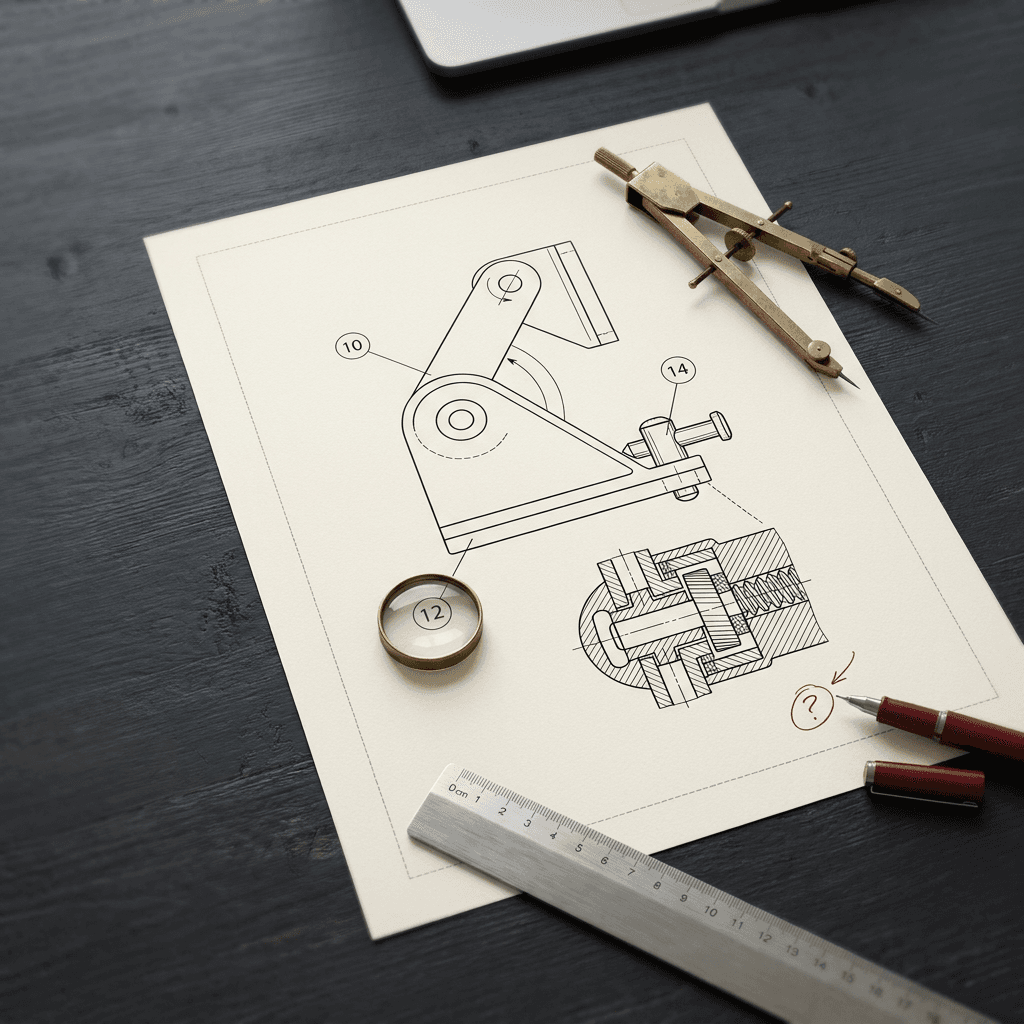
Each element of the invention must carry the same reference number in every figure where it appears. A component labeled 12 in Fig. 1 must be labeled 12 in Fig. 3 and Fig. 5. Any variation creates a formal defect and potential disclosure issues.
Alignment with the Spec
Every reference number in the drawings must appear in the written description, and vice versa. Numbers that appear in the spec but not the figures — or in the figures but not the spec — are objectable and signal a disconnect in the drafting process.
Leader Lines
Leader lines connecting reference numbers to their components must be unambiguous — pointing clearly to the element, not crossing other lines or floating near multiple features. Ambiguous leaders invite examiner questions about what is actually being claimed.
Text in Drawings
Drawings should contain minimal text. Short labels are acceptable where necessary, but substantive description belongs in the spec. Text within figures must meet minimum size requirements — text too small to read at reproduction scale is a common objection.
Required Views by Patent Type
Missing views are a predictable source of objections — particularly in design patent prosecution, where the view requirements are specific and sequential.
Utility Patents
The USPTO requires enough views to fully disclose the invention. What "enough" means depends on the invention. Common view types include perspective views, plan and elevation views, cross-sections, and flowcharts for method claims. The test is whether a person of ordinary skill in the art could understand and reproduce the invention from the drawings and description together.
Practical Note — Utility
Cross-sectional views are frequently under-specified at the instruction stage, especially for mechanical inventions with internal components. If the illustrator is not briefed on which section planes are needed, they default to the most obvious cut — which may not be the most disclosing one. This is a brief quality problem, not a drawing quality problem.
Design Patents
Design patent drawings are more prescribed. The standard set for a three-dimensional product is seven views: perspective, front, rear, left side, right side, top, and bottom. Every surface that forms part of the claimed design needs to be shown. Broken lines are used to show unclaimed environmental structure; solid lines define what is claimed. Shading is not required but is strongly recommended — surface contour is often what distinguishes one design from another, and flat line drawings can fail to capture it.
Practical Note — Design
The most common design patent drawing problem is inconsistency across views. A feature shown in solid lines in the perspective view should not appear in broken lines in the plan view unless the intent to disclaim it is deliberate and documented. Cross-view consistency needs a final review pass before submission — this is not something to catch during examination.
The Objections That Were Preventable
The USPTO issues drawing objections under 37 CFR 1.84 on a regular basis. Most of them cluster around the same set of issues. Here are the ones that come back most often — and what they actually reflect about the process that produced the drawings.
Content inside the margin zones. Almost always a template problem. If the illustrator is not working from a pre-configured drawing template with locked margin guides, this error is effectively random — it depends on how carefully the illustrator eyeballs the placement each time.
Text too small to reproduce cleanly. Reference numbers and labels must be legible at the size they will appear in the published patent. This requires knowing the expected reduction ratio before finalising the drawing — not after.
Inconsistent line weight. Often a symptom of the drawing being produced in multiple sessions, on different software versions, or by different hands. A quality control pass comparing line weights across all figures should be standard — it rarely is.
Missing views. For design patents especially, the omission of a required view is not caught until the examiner's first action. It always adds at least one response cycle. The fix is a pre-submission view checklist against the claim type — not a reactive correction.
Reference number mismatches between figures and spec. Typically introduced during late-stage amendments to the claims or description, where the drawing was not updated in parallel. The only reliable fix is a spec-to-figure cross-reference check as a closing step before every filing.
The Common Thread
None of these objections are hard to prevent. They are process failures — the kind that happen when drawings are treated as a deliverable to be produced rather than a component to be managed through a controlled workflow. The cost of each objection is not just the correction fee. It is the attorney time, the docketing adjustment, and the accumulated drag on a practice that cannot afford unnecessary cycles.
What Controlled Drawing Execution Actually Looks Like
The difference between a drawing set that sails through examination and one that generates a 1.84 objection is not the quality of the illustrator's line work. It is whether the production process has checkpoints built in — or whether compliance is assumed until the examiner says otherwise.
Brief quality determines drawing quality. An illustrator working from a vague instruction set will make judgment calls. Those calls will not always align with what the attorney intended or what the USPTO requires. A structured brief — specifying view requirements, section planes, solid vs. broken line intent, and reference numbering logic — reduces revision cycles before a single line is drawn.
Revision cycles need to be traceable. When corrections happen across multiple rounds, version control matters. A drawing set where fig_final_v3_revised_FINAL.pdf is the operative document is a liability waiting to be filed. Each version should be named, dated, and tied to a specific review action.
The pre-filing review is not optional. A formal check against the 37 CFR 1.84 requirements before every submission — margins, views, line quality, reference consistency — catches the preventable objections before they become examiner actions. This is not a long process. It is a checklist that should take minutes, not hours.
For IP firms managing volume, the firms that absorb the least drawing-related friction are the ones that have structured this workflow — not the ones relying on experienced illustrators to catch their own mistakes.